
Greensboro's African American Community Newspaper since 1967
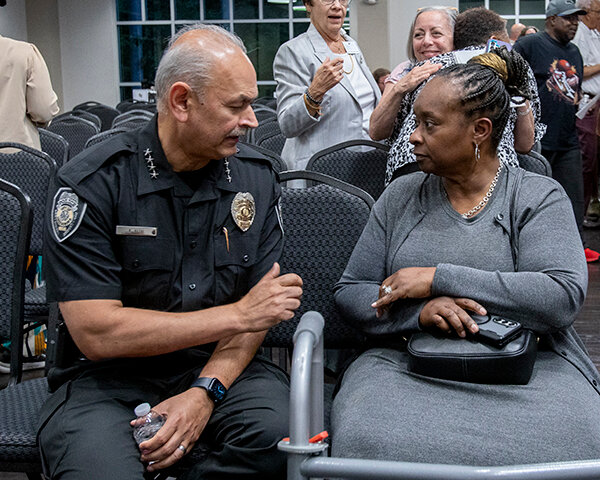

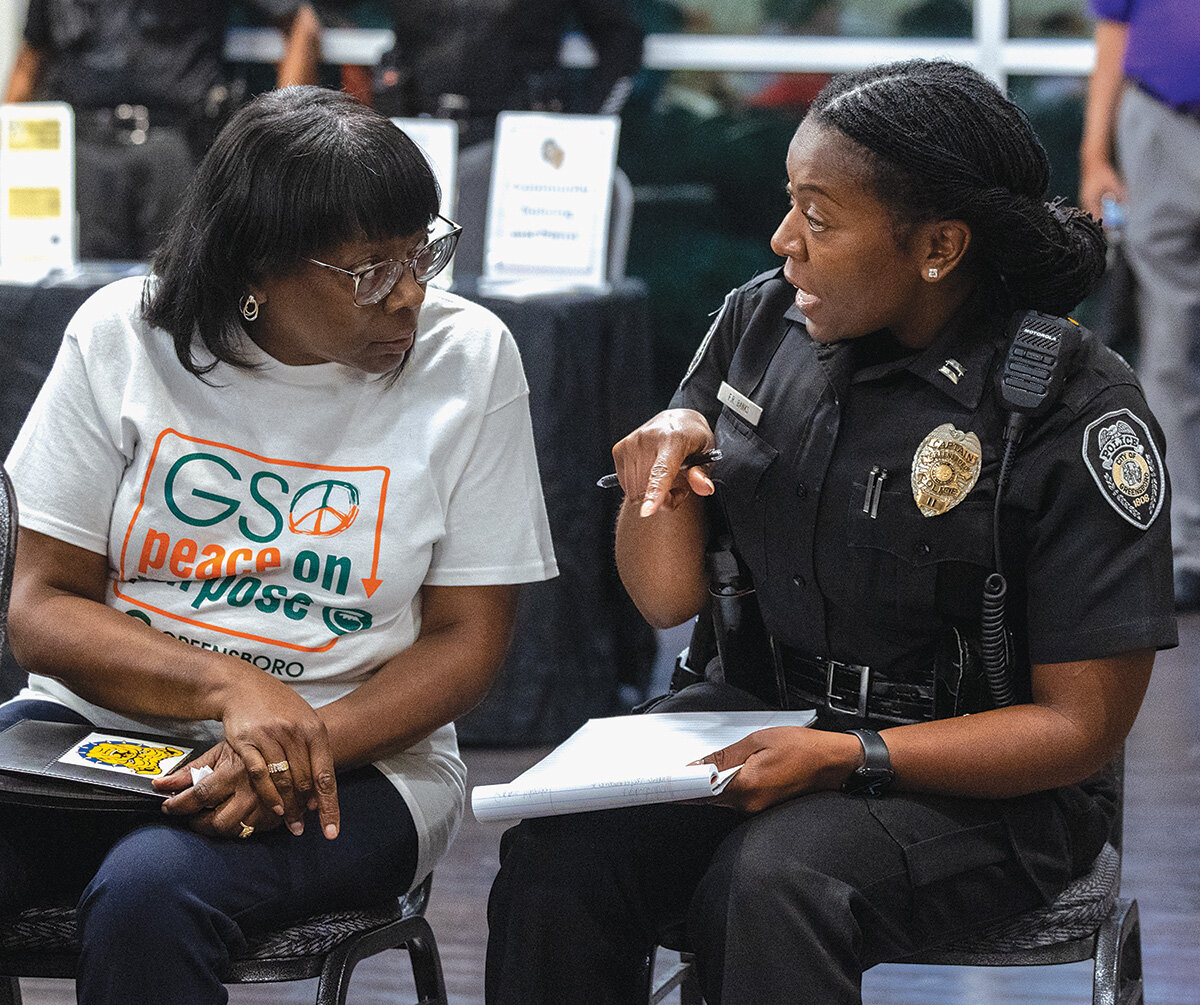



Questions about accountability, transparency and police-community relations dominated the first two public meetings hosted by Greensboro Police Chief Kamran Afzal as residents sought answers from the city’s new top law enforcement officer during his first 30 days on the job.
More than 100 residents attended meetings at Peeler Recreation Center and Barber Park Event Center, the first in a series of six community conversations designed to introduce Afzal to Greensboro residents and allow community members to raise concerns directly with the new chief.
The discussions came just weeks after Afzal’s appointment sparked criticism from some community leaders and activists who questioned the transparency of the hiring process led by City Manager Trey Davis and called for greater public input before a final selection was made.
Despite those concerns, Afzal told residents he is committed to learning about Greensboro and building relationships across the city.
“As a human being and an executive of the police department, first and foremost, our job is to be a citizen of the community,” Afzal said. “That might mean we issue traffic citations, that might mean we arrest an individual, but it also means we find more ways to partner with our community to address issues at not just a symptom level, but who can we bring in to help address these symptoms.”
Throughout both meetings, residents repeatedly returned to questions about transparency and accountability.
Rev. Greg Drumwright, a local activist with Justice 4 The Next Generation and one of the most vocal critics of Afzal’s hiring, sought to clarify what he described as public misconceptions surrounding the opposition campaign.
“It was actually proactivity regarding the concern for a more transparent hiring process that brought you here and the data driven policing in Greensboro,” Drumwright said before asking about Afzal's stance on releasing police body-camera footage.
“My perspective is, I’m going to show our perspective, whether it’s good, bad or indifferent,” Afzal responded. “I don’t know what the officer was thinking, I can only show what the camera shows and doesn’t show.”
Afzal also addressed concerns about being an outsider coming into the department and the city.
“There’s a reason I moved here. I love the atmosphere; I love the environment. This is a great community from my perspective,” he said. “I only think positive things about Greensboro.”
Questions about traffic enforcement and policing practices also surfaced repeatedly.
Jason Hicks, another community activist who opposed Afzal’s hiring, reiterated concerns about regulatory traffic stops and called for written consent to search policy. Hicks noted that while African Americans make up roughly 45 percent of Greensboro’s population, they account for approximately 60 percent of traffic stops.
“I just want to highlight those things publicly in hopes there will be change under your leadership,” Hicks said.
Dr. Mahunda Abdul-Mbacke followed by asking whether Afzal would commit to reducing police involvement in low-level offenses, including minor traffic violations and other nonviolent quality-of-life issues.
Afzal said he was not prepared to make policy commitments before fully reviewing current practices.
“There’s no such thing as ‘yes’ or ‘no’ in my line of work, so I need to understand what we have and why we’re doing what we’re doing before I get to that,” Afzal said.
“What I’m committed to is being fair and impartial from a policing perspective.”
Abdul-Mbacke also raised concerns about how the department plans to police North Carolina A&T State University’s upcoming homecoming celebration, which will mark the 100th anniversary of the event known as “The Greatest Homecoming on Earth.”
“We are the home of Aggie Pride here and we are coming up on the 100th homecoming anniversary,” Abdul-Mbacke said. “That means there’s going to be tens of thousands of African Americans, highly educated, ready to have fun and be welcomed by the city they were educated in. It’s a point of fact for you to know ahead of time, so that when those people come back to celebrate, they are made to feel welcomed, not made to feel harassed, not made to feel that they are being patrolled or any way discriminated against.”
Afzal said he is aware of the significance of the event.
“I’m completely aware of the 100-year anniversary, and I look forward to that,” he said. “Hopefully we’ll have a good impression with the individuals that come into town.”
Building trust between the police department and residents emerged as another recurring theme.
Community member Irish Good asked how Afzal plans to strengthen relationships between officers and the public.
“Day by day, step by step, following up with the community’s concerns,” Afzal said. “To me, words don’t mean anything; actions mean everything. It’s not something that we’re just going to do today, this is just a start of the conversation.”
At the Barber Park meeting, Carolyn Smith, secretary of the Dudley Heights Neighborhood Association, emphasized the historical significance and character of Greensboro’s District 1 neighborhoods and asked how Afzal intends to engage with communities he is still getting to know.
“I’m not going to pretend that I know the community,” Afzal said. “The intent is to make sure that I understand the uniqueness of each patrol district and work with my staff to understand the historical perspective of the district.”
Residents at Barber Park also raised concerns about police response times in communities of color, the citizen complaint process, immigration enforcement and youth engagement.
Afzal said he has already begun reviewing the department’s citizen complaint process but was not yet prepared to discuss potential changes.
When asked about local police involvement in immigration enforcement, Afzal gave a direct response.
“I don’t think that local police should have a role in that,” he said.
Charles McDuffie, who has lived in Greensboro for nine years, challenged the department to engage young people before they encounter the criminal justice system.
“I’m not just talking about my Black kids,” McDuffie said. “I’m talking about all of our children. How does the police department build those relationships?”
Afzal pointed to school resource officers and the Family Justice Center’s summer camp programs as existing opportunities for officers to build positive relationships with young people.
“Part of that is addressing how do we utilize our SROs when the kids are out of school,” he said.
As the meetings concluded, Afzal said the conversations are an important step toward building stronger relationships between the department and the communities it serves.
“I believe we are here to serve our community,” Afzal said. “What evidence has told us is that the way to really resolve these issues is to talk directly to the community.”
Four community meetings remain scheduled this month:
Jun. 15- Brown Recreation Center, 6:30 p.m.
Jun. 22- Leonard Community Recreation Center, 6:30 p.m.
Jun. 25- Lindley Recreation Center, 6:30 p.m.
Jun. 29- Guilford Park Presbyterian Church, 6:30 p.m.


