Greensboro's African American Community Newspaper since 1967




As 2025 comes to a close, Greensboro reflects on a year shaped by public safety concerns, political change, major economic investments, community activism, and the loss of revered civil rights leaders. From City Hall to church sanctuaries and manufacturing plants, the year’s top stories captured a city navigating growth, accountability and remembrance.
The year opened with heightened concern over violent crime after six homicides were recorded in the first two weeks of 2025. In response, the Greensboro Police Department launched a series of community meetings aimed at strengthening collaboration between residents and law enforcement.
While the early months were tense, citywide data later showed progress. Greensboro ended 2024 with 43 homicides, a sharp decrease from 74 in 2023. As of December 29, 2025, the city had recorded at least 42 homicides for the year and reported an overall 23 percent decrease in violent crime compared to 2024.
The city’s Community Safety Department and GPD continued neighborhood-based initiatives throughout the year. In December, officials announced the launch of the Greensboro Collaborative Action Network (GSO CAN), a community-driven effort uniting residents, faith leaders, educators, public health professionals, and public safety partners to develop long-term violence prevention strategies.
Concerns over policing and use of force again took center stage in 2025. On June 4, the activist group F.R.E.E. Guilford held a public meeting at Prestige Barber College on Phillips Avenue, calling attention to what it described as systemic injustice and police violence.
The meeting followed a May 14 traffic stop involving three young Black men, Damonta Glover, Savon Johnson, and A’mon Moore, that was recorded on a cellphone and widely shared. The video showed an officer pointing a firearm while issuing commands. GPD officials stated that two of the individuals resisted exiting the vehicle and maintained that departmental protocols were followed.
The group renewed its demands during a November 3 press conference, held the day before Election Day, calling for an end to regulatory traffic stops, the elimination of “stop and frisk” practices, and the adoption of a written consent policy for searches.
Greensboro Police Chief John Thompson announced plans to retire in early 2026, prompting the city to begin a national search for his successor. Thompson, who joined the department in 2003 and became chief in December 2022, previously served with the Asheboro Police Department.
The city contracted with Developmental Associates, LLC, the same firm used in Greensboro’s previous two chief searches. Community input sessions were held across all city districts to gather feedback on priorities for the next chief.
City Manager Trey Davis said an interim chief is expected to be appointed from within the department following Thompson’s departure, with the goal of naming a permanent chief by spring 2026.
Municipal elections dominated local headlines in 2025 as Greensboro voters ushered in significant changes at City Hall. Six new City Council members were elected and sworn in during December, dubbing it a “generational shift.”
Crystal Black won the District 1 seat, Cecile Crawford was elected in District 2, April Parker captured District 3, and Adam Marshall took the District 4 seat. Irving Allen and Denise Turner Roth were elected to at-large positions, with Roth becoming Mayor Pro Tem after leading the at-large vote count.
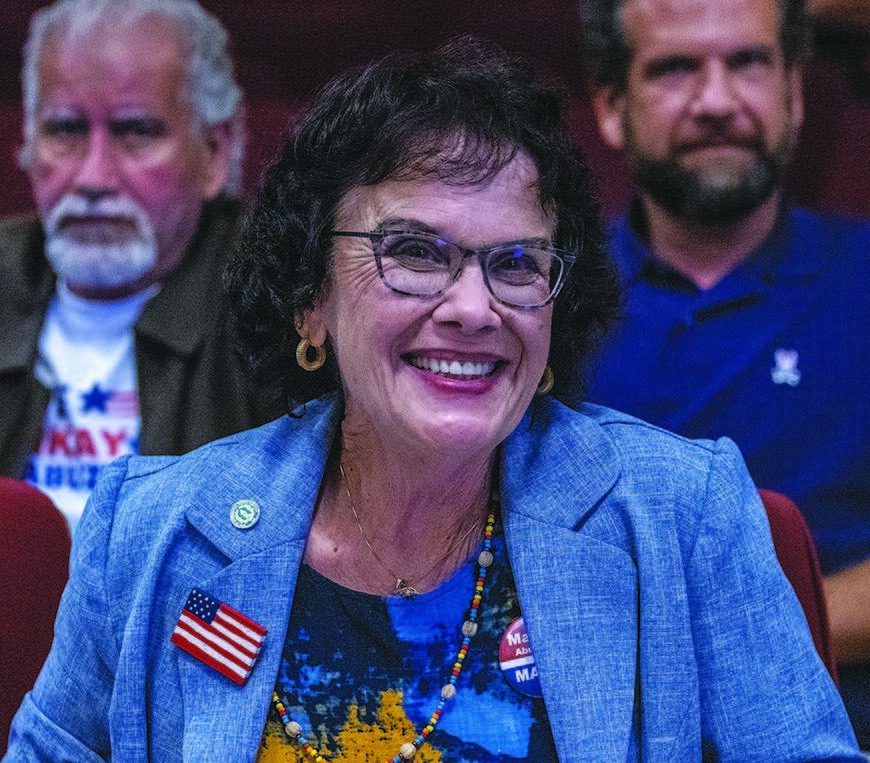
Marikay Abuzuaiter left her longtime at-large role to win the mayor’s race, defeating former mayor Robbie Perkins. At-large council member Hugh Holston and District 5 representative Tammi Thurm both retained their seats.
In December, the newly seated City Council approved plans to redevelop a gravel lot at 734 S. Elm Street into a mixed-use development featuring housing and retail space. Wisconsin-based developer, Alexander Company, proposed 128 apartment units and 29,000 square feet of commercial space, including the potential for a grocery store.
The project was selected over a competing proposal from local developer, Andy Zimmerman, after months of discussion with the Greensboro Redevelopment Commission. While some residents welcomed the addition of housing, others raised concerns about concentrating low-income developments in southeast Greensboro. The developer agreed to address those concerns in a revised proposal expected in early 2026.
Greensboro strengthened its position as a regional economic engine in 2025, driven by large-scale manufacturing investments. Toyota Battery Manufacturing North Carolina transitioned from construction to active operations in nearby Liberty, officially launching production in November. The $13.9 billion project is expected to support approximately 5,100 jobs.
At Piedmont Triad International Airport, Boom Supersonic continued construction of its Overture Superfactory, a $500 million investment projected to create more than 1,750 jobs by 2030.
Adding to the momentum, JetZero announced plans for a $4.7 billion headquarters and manufacturing facility at the airport, with projections of more than 14,500 jobs. The company expects a demonstrator test flight in 2027 and commercial service by 2030. Local universities and community colleges, including N.C. A&T State University expanded workforce training programs to meet industry needs.
Mount Zion Baptist Church and Novant Health unveiled a multiphase healthcare partnership aimed at expanding medical access and creating jobs. The initiative includes a mobile health clinic, telehealth services within the church, and plans for a two-story, 40,000-square-foot medical office building on Mount Zion’s Zion Hills campus.
The future facility is expected to offer primary care, women’s health, pediatrics, diabetes management, heart and vascular care, imaging, lab services, and community health support, while generating more than 60 full-time jobs in Guilford County.
The city mourned the loss of two towering figures in civil rights history. Rev. Nelson Johnson, founding pastor of Faith Community Church and co-executive director of the Beloved Community Center, died on February 9 at age 81. A survivor of the 1979 Greensboro Massacre, Johnson later led the Greensboro Truth and Reconciliation Commission, which culminated in a formal City Council apology in 2017.
In September, Greensboro also lost Joseph McNeil, a member of the A&T Four, at age 83. McNeil, an N.C. A&T graduate and Air Force veteran, was honored with multiple memorial services. His legacy, alongside that of his fellow protesters, remains immortalized by the February One Monument on A&T’s campus.
Following the January inauguration of President Donald J. Trump, proposed federal cuts to healthcare, SNAP benefits, and diversity initiatives, along with expanded immigration enforcement, prompted widespread concern locally.
Greensboro saw thousands gather downtown during the “Hands Off” protests in April and the “No Kings” demonstrations in June, reflecting the city’s continued role as a hub for civic engagement and political expression.


